
In the traditional corporate world, the Friday Project Status Report (PSR) is a holy ritual. PMs spend hours condensing data. Meanwhile, stakeholders spend minutes skimming it – or ignoring it entirely. Indeed, this “Push” model of communication is failing. It creates a dangerous gap between the data that exists and the insights leaders actually need.
The Challenge – Information Blindness
The classical PSR relies on a “Push” mechanism. The PM decides what is important, filters the details and sends a static document. However, this creates two major risks:
- The Granularity Paradox
- If the report is too detailed, the C-suite stops reading. If it is too high-level, critical roadblocks stay hidden.
- The Expiry Date
- By the time a PDF is circulated, the “truth” on the ground has already shifted.
Consequently, most global strategies hit friction because they are steered by obsolete data.
The Solution – Pull it, instead of push it
As a Strategic Architect, I believe we must flip the script. We are moving from a “Push” model to an active project intelligence “Pull” model.
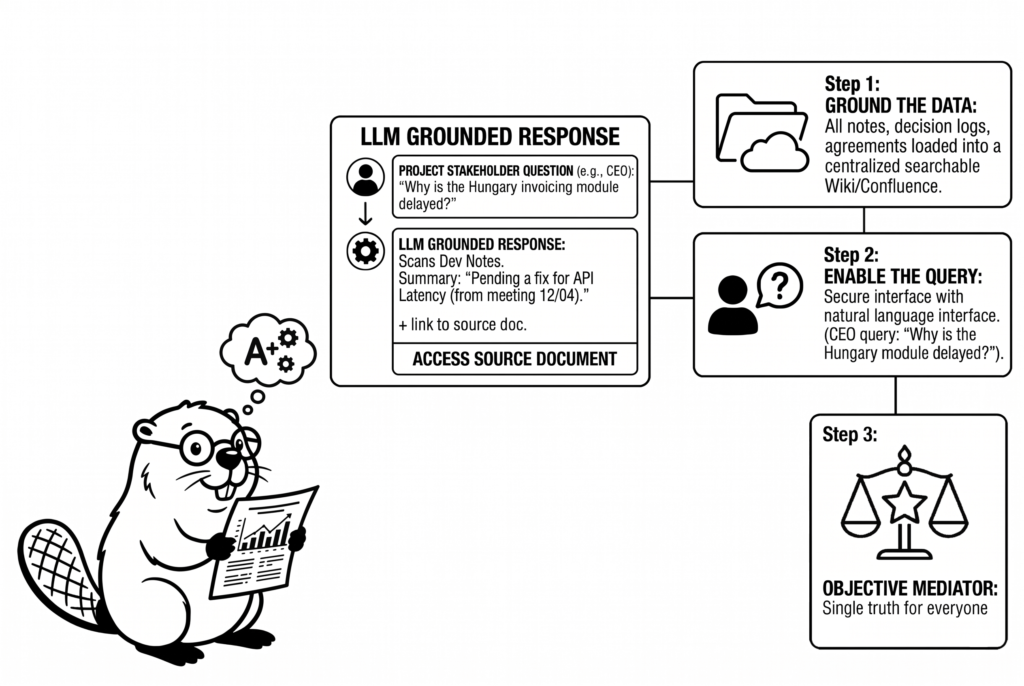
Instead of guessing what a stakeholder needs to know, we provide a Grounded Truth Engine. By using Large Language Models (LLMs) integrated with your project’s Knowledge Base (Confluence, Jira or meeting notes), we allow stakeholders to pull exactly the information they need, at the exact depth they require.
The Implementation Logic
Transitioning to a “Pull” system isn’t just about the tech; it’s about the Architecture of Information.
- Step 1 – Ground the Data
- Your LLM is only as good as its “grounding.” You must ensure all meeting notes, decision logs and agreements are loaded into a centralized repository like a Wiki or Confluence.
- Step 2: Enable the Query
- Instead of a weekly email, stakeholders use a secure interface. A CEO can now ask: “Why is the Hungary invoicing module delayed?”
The LLM doesn’t just guess; it scans the latest notes and provides a summary plus a direct link to the source document.
- Instead of a weekly email, stakeholders use a secure interface. A CEO can now ask: “Why is the Hungary invoicing module delayed?”
- Step 3: Establish the Single Source of Truth
- In a “Pull” system, there is no “my version” vs. “your version” of the status. Therefore, the LLM acts as the objective mediator. Everyone, from the intern to the Chairman, pulls from the same grounded data.
The Executive Advantage
For the C-suite, this is a liberation from Information Chaos. It provides:
- Real-time Clarity
- No more waiting until Friday for a “Red” status
- Custom Depth
- A CFO can ask about budget; a CTO can ask about API latency
- Reduced Friction
- The PM stops being a “reporter” and starts being a “builder”
The K2XP Takeaway
Mastery isn’t about how much information you send; it’s about how accessible you make the truth. By moving to a “Pull” mechanism, you dismantle the barriers between strategy and execution.
Is your organization still trapped in the “Push” cycle of obsolete PDFs and executive blindness?
 English
  Hungarian
Leave a Reply