
In high-growth companies, moving from startup to leader rarely follows a straight line. It’s a series of scaling pains. A small team becomes hundreds across departments, and the informal ’email and Google Docs’ workflow that once represented freedom suddenly becomes a dangerous trap.
But the real crisis often begins when the organization tries to fix that trap with the wrong tools. Instead of finding balance, teams often find themselves stalked by the Agile Beast — a misunderstood, rigid version of “process” that threatens to devour the very creativity and autonomy that built the brand. For a non-IT culture, this “Beast” isn’t a solution; it’s a foreign invader that turns every sprint into a struggle and every backlog into a burden.
The Challenge
I joined a highly successful, fast-evolving manufacturer that had outgrown its “garage-days” workflows. The organization didn’t run on IT; physical products and creative design drove its success. While the PMO team understood the power of Atlassian tools like Jira and Confluence, the broader business viewed them with deep-seated suspicion.
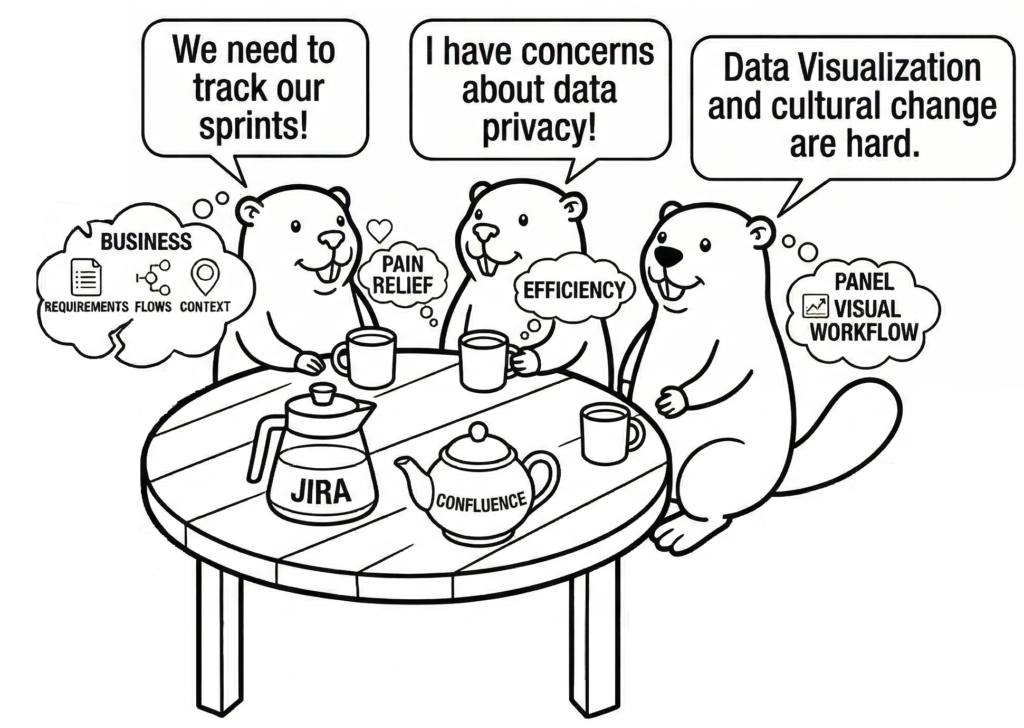
To a non-technical stakeholder, terms like “Backlog“, “Kanban” or “Agile” didn’t just sound like unnecessary complexity — they sounded like the enemy. In a culture built on physical craftsmanship, these felt like IT “swear words” with no place in their world. Since we weren’t an IT company, they questioned why they had to speak a foreign language.
The team protected their way of working with a wall of resistance. they feared that “Agile” was a cage that would strip away their autonomy and kill their creative spirit. Our task wasn’t just to install software; we had to prove that structure isn’t a cage for creativity — it is the foundation that protects it.
Our Response
Rather than mandating a new toolset from the top down, we acted as Translators. We knew a “software rollout” would fail, so we treated the project as a Cultural Migration.
We built our strategy on three pillars:
- Active Listening over Manuals: We arranged countless alignments to listen to the specific fears of the business teams. We didn’t discuss “software features”, we talked about “reclaiming your Friday afternoons”.
- The “Low-Hanging Fruit” Strategy: We hunted for the most painful manual processes — those buried in email threads — and moved them into Jira. By demonstrating immediate “pain relief,” we gained trust and earned the right to implement the larger system.
- Translating the Lexicon: We bridged the gap between IT terminology and business reality. We showed how a “Backlog” simply means a prioritized “To-Do” list and how a “Kanban Board” provides a visual way to ensure no one feels overwhelmed.
The Result
With the support of a specialized consultancy, we did more than “install” a tool; we established a Unified Work Pattern. We integrated a robust Jira framework with well-elaborated Confluence templates to standardize information sharing and decision-making.
Today, reliance has replaced resistance. The team now speeds up alignments and decisions because “Business Memory” no longer hides in an inbox — it is visible, searchable and accessible to everyone. We shifted the culture from “passing documents” to “co-creating value“.
The K2XP Takeaway
The best tools in the world are useless if your team treats them like a foreign language. Scaling requires a bridge between the logic of a system and the reality of the human being using it.
We help companies translate complex frameworks into simple, high-impact workflows.
 English
  Hungarian
Leave a Reply