
“Do you have a minute for a quick update?” This question is the silent killer of project momentum. Indeed, most Project Managers treat these interruptions as part of the job. However, every “shoulder-tap” is actually a symptom of a structural information leak. If stakeholders must ask you for an update, your transparency is an illusion. Therefore, we must move beyond manual reporting and build an Architecture of Transparency. We need a system that provides answers before the questions even arise.
The Challenge – The Information Gatekeeper Trap
Traditional project management often turns the PM into a human bottleneck. This creates three critical failures:
- The Interruption Tax
- Every “quick question” shatters your focus. Consequently, you spend your day talking about work instead of actually doing it.
- Every “quick question” shatters your focus. Consequently, you spend your day talking about work instead of actually doing it.
- The Uncertainty Gap
- When stakeholders cannot see the progress themselves, they lose confidence. They don’t know if the next step has been triggered. As a result, the project stalls in a cloud of “I didn’t know it was my turn“.
- When stakeholders cannot see the progress themselves, they lose confidence. They don’t know if the next step has been triggered. As a result, the project stalls in a cloud of “I didn’t know it was my turn“.
- The Accountability Fog
- A lack of transparency allows underperformance to hide. By removing the fog, you ensure there is nowhere for delays to hide. Clarity and accountability leverage effectiveness without much ado.
In short, being an “Information Gatekeeper” is a low-value role. You must become a Transparency Architect.
The Solution – The Self-Service Engine
The goal is simple: Zero-Inquiry Management. You must create a shared, digital environment where stakeholders can “pull” data whenever they want.
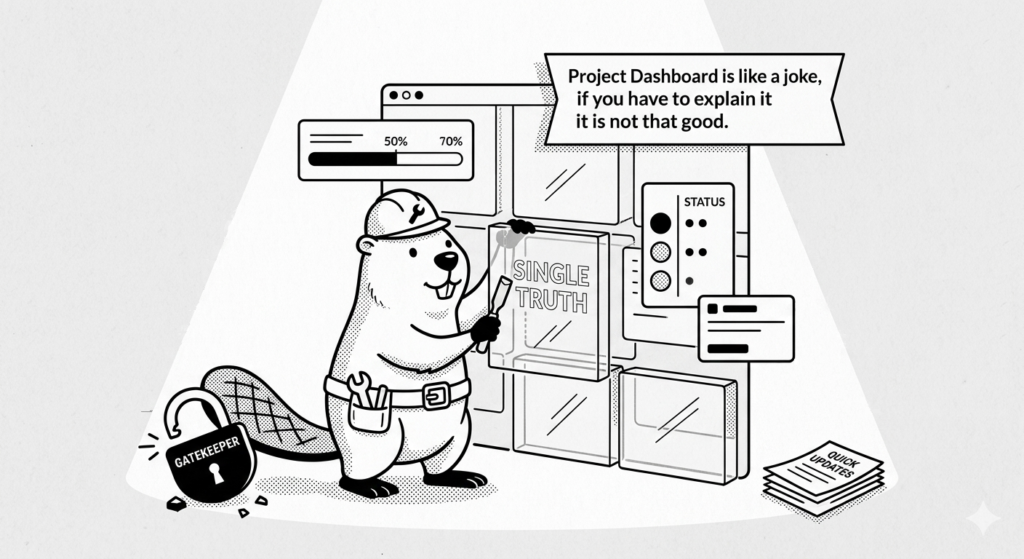
By using a central dashboard in Jira or Confluence, you move from a “Push” model to a “Self-Service” model. Furthermore, by integrating LLMs into this stack, you provide an interface where stakeholders can simply ask, “What is blocking the API migration?” and get an instant, grounded answer. Eventually, you eliminate 80% of status inquiries. The answers are always accessible, so the interruptions simply stop.
The Implementation Logic: The Open-Door Dashboard
To build this architecture, you must automate the flow of truth.
- Enforce Real-Time Jira Health
- Your dashboard is only as good as your data. Specifically, ensure every ticket has an updated status and a clear “Target Date”. This data serves as the “Ground Truth” for your LLM / ensures that your Jira Dashboards remain alive.
- Your dashboard is only as good as your data. Specifically, ensure every ticket has an updated status and a clear “Target Date”. This data serves as the “Ground Truth” for your LLM / ensures that your Jira Dashboards remain alive.
- Construct the Confluence “Mission Control”
- Create one central page for high-level stakeholders. Instead of deep Jira links, use visual widgets to show progress bars. Then, insert an AI Chat Interface. This allows leaders to query project health using natural language. Use the “Traffic Light” system (Red/Amber/Green) for instant clarity.
- Create one central page for high-level stakeholders. Instead of deep Jira links, use visual widgets to show progress bars. Then, insert an AI Chat Interface. This allows leaders to query project health using natural language. Use the “Traffic Light” system (Red/Amber/Green) for instant clarity.
- Deploy the AI “Status Agent”
- Connect an LLM to your Jira and Confluence workspace. Rather than browsing through boards, stakeholders can ask the agent for a 24-hour summary. Consequently, the AI synthesizes the data while you stay focused on execution.
- Connect an LLM to your Jira and Confluence workspace. Rather than browsing through boards, stakeholders can ask the agent for a 24-hour summary. Consequently, the AI synthesizes the data while you stay focused on execution.
- Mandate the “Link-First” Response
- When a stakeholder asks for an update via email or Chat, do not type the answer. Rather, send them the link to the Jira dashboard or the AI agent. Consequently, you train them to use the self-service engine instead of relying on your manual labor.
The Executive Advantage – Insight Without Friction
For the C-suite, this architecture is a liberation from Information Fog. It provides:
- Instant Visibility
- Leaders see the project health at 2:00 AM without calling a meeting.
- Leaders see the project health at 2:00 AM without calling a meeting.
- One and Only Truth
- You remove the “middleman” from the data flow. What they see is the raw reality of the Single Project Truth.
- You remove the “middleman” from the data flow. What they see is the raw reality of the Single Project Truth.
- Total Accountability
- The dashboard shows exactly where the project stands. Consequently, it highlights who needs to act next, leaving no room for “accidental” delays.
The K2XP Takeaway
Mastery is about building systems that speak for themselves. By dismantling the shoulder-tap and building an Architecture of Transparency – supercharged by AI – you reclaim your focus. You stop being a reporter and start being an architect. Your project does not need a “quick update”, it needs a Single Source of Truth that is smart enough to explain itself.
Stop being the bottleneck for your own project’s information!
Build a Single Source of Truth that is smart enough to explain itself.
 Hungarian
  English
Vélemény, hozzászólás?